

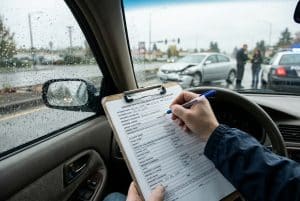
If you were injured in a collision, working with an experienced Portland car accident lawyer can help you understand your reporting obligations, insurance coverage, and options for pursuing compensation.
Mandatory Statutory Thresholds: Oregon DMV Driver Reporting Rules
Under ORS 811.720, drivers involved in qualifying motor vehicle collisions must submit an Oregon Traffic Collision and Insurance Report (Form 735-32) to the Oregon Driver and Motor Vehicle Services (DMV) within 72 hours.
A report is required when any of the following circumstances applies:
- Injury or Death: Any injury, regardless of severity, or a fatality resulting from the collision.
- Damage to Your Vehicle: Damage to the vehicle you were driving exceeds $2,500.
- Damage and Towing: Damage exceeding $2,500 to any involved vehicle when any vehicle must be towed from the scene because of collision damage.
- Damage to Other Property: Damage exceeding $2,500 to property other than a vehicle involved in the collision, such as a guardrail, utility pole, mailbox, or building.
For property-damage reporting requirements, the collision must occur on a highway, premises open to the public, or premises adjacent to a highway or publicly accessible premises.
Importantly, damage exceeding $2,500 to another vehicle does not independently trigger the driver’s reporting requirement unless an involved vehicle is also towed from the scene because of collision damage. The damage to the vehicle you were driving, however, independently triggers the requirement when it exceeds $2,500.
Review the Oregon DMV’s official collision reporting requirements if you are unsure whether your accident qualifies.
Why a Police Crash Investigation Does Not Substitute for Your DMV Report
A common misconception among drivers in Multnomah, Washington, and Clackamas counties is that having a police officer investigate an accident automatically satisfies all state reporting obligations. It does not.
Oregon law establishes separate reporting responsibilities for responding officers and involved drivers.
“`html
1. Law Enforcement Reporting Duty (ORS 810.460)
Under ORS 810.460, police officers must submit an accident report to the Department of Transportation when they investigate a qualifying vehicle accident or prepare a report based on an investigation or interviews with participants or witnesses.
Officers generally have 10 days after investigating or preparing the report to submit it.
This requirement fulfills the officer’s independent reporting responsibility. It does not eliminate the driver’s separate obligation to file with DMV.
2. Driver Reporting Duty (ORS 811.720 and ORS 811.725)
Under ORS 811.720 and ORS 811.725, drivers involved in qualifying collisions must complete and submit their own report within 72 hours.
The report includes important information about the collision, the vehicles involved, and the driver’s insurance coverage. Drivers must also provide the required proof of financial responsibility.
Oregon DMV expressly confirms that drivers must submit their own reports even when law enforcement has already filed a police report.
Consequences of Failing to File (ORS 811.725)
Failing to submit a required Oregon Traffic Collision and Insurance Report within 72 hours can have consequences beyond an incomplete accident record.
Under ORS 811.725, failure to report a qualifying collision is a Class B traffic violation. Oregon DMV also states that it must issue a suspension notice when a driver fails to submit a required report.
The law additionally requires drivers to provide proof of compliance with Oregon’s financial responsibility requirements.
If you miss the 72-hour deadline, submit the report as soon as possible rather than assuming it is too late. Contact Oregon DMV if you have questions about your reporting obligation or driving privileges.
How Oregon PIP Insurance Covers Medical Expenses After a Crash
Oregon requires Personal Injury Protection (PIP) coverage in qualifying motor vehicle liability policies under ORS 742.520. These benefits help cover certain medical expenses and lost income regardless of who caused the collision.
Under ORS 742.524, the minimum statutory PIP benefits include:
- Medical Expenses: Up to $15,000 for reasonable and necessary covered medical expenses incurred within two years after the injury.
- Lost Income: Generally 70% of qualifying lost income, subject to a $3,000 monthly maximum and a maximum benefit period of 52 weeks. The injured person must meet the statutory disability requirements.
- Essential Services: Eligible individuals who are not usually engaged in a remunerative occupation may receive up to $30 per day for qualifying essential services, subject to a maximum benefit period of 52 weeks.
The two-year period applies to covered medical expenses, not all PIP benefits.
When completing your DMV collision report, provide accurate insurance company and policy information. DMV verifies the insurance information you submit, and incomplete insurance information can create additional administrative complications.
PIP coverage does not eliminate your right to pursue a fault-based personal injury claim against a negligent driver.
If the driver who caused your crash is uninsured or underinsured, see our detailed guide on What Happens If You Are Hit by an Uninsured or Underinsured Driver in Portland to understand how your UM/UIM coverage may protect you.
Step-by-Step Instructions: How to Complete Your Oregon DMV Collision Report
To ensure your filing is complete, follow these steps when submitting your Oregon Traffic Collision and Insurance Report.
1. Gather the Required Information
Before starting your report, collect the following information:
- Your driver’s license number.
- Your vehicle’s license plate number and VIN.
- Your vehicle’s year, make, and model.
- Your insurance company’s name and policy number.
- Information about other drivers and vehicles involved, if available.
- The date, time, and location of the collision.
Use the insurance company’s name rather than your local insurance agent’s contact information.
2. Choose an Official Filing Method
Oregon provides two ways to submit your collision report:
Online through DMV2U: The online collision reporting service is generally the fastest and most secure option. However, you must be a driver involved in the collision and have an Oregon driver’s license, permit, or identification number to use it.
Paper Form 735-32: If you do not meet the online eligibility requirements, download the official Oregon Traffic Collision and Insurance Report. You can submit the completed form by mail, fax, or in person at a DMV office.
3. Provide Accurate, Factual Information
Describe the collision as accurately as possible. Include the date, time, location, weather conditions, road conditions, and factual sequence of events.
Avoid guessing about vehicle speeds, making assumptions about another driver’s actions, or speculating about fault. If you do not know a particular detail, do not invent an answer.
Oregon DMV does not determine fault in a collision. Its purpose in collecting the report is to maintain the required collision and insurance information.
4. Save a Copy of Your Completed Report
Before submitting your report, print or download a copy for your personal records.
Under ORS 802.220 and Oregon DMV’s filing instructions, the department does not provide drivers with a copy of the collision report they submitted. Keeping your own copy and proof of submission is therefore important.
Additionally, do not submit multiple reports for the same collision. Oregon DMV warns that each submission may appear as a separate collision on your driving record.
Local Insights & Case Experience: Portland Car Accident Reporting
According to the City of Portland’s Vision Zero program, Portland typically experiences between 10,000 and 12,000 reported traffic crashes annually. These incidents range from minor property-damage collisions to serious crashes involving significant injuries and fatalities.
Portland’s crash reporting system contributes to the broader traffic safety data maintained by the Oregon Department of Transportation. This information helps transportation officials identify collision patterns and evaluate roadway safety.
For injured drivers, understanding the distinction between a DMV collision report and a police investigation is particularly important. Oregon DMV does not determine fault, and submitting a collision report does not establish that a particular driver caused the accident.
However, insurance companies independently investigate collisions and evaluate available evidence when determining liability and compensation. Photographs, witness statements, vehicle damage, medical documentation, and other supporting evidence can all play important roles in evaluating a personal injury claim.
Oregon follows a modified comparative fault system under ORS 31.600. An injured person may recover damages if their fault is not greater than the combined fault of the parties whose fault is considered under the statute. Any recovery is reduced in proportion to the injured person’s percentage of fault.
At Dawson Law Group, attorneys Bryan Dawson and Ben Larson bring experience from both sides of personal injury litigation. Their background in representing injured people and working with insurance defense counsel provides valuable perspective when evaluating collision evidence, insurance disputes, and liability arguments.
The firm’s reported case results include:
- $2.5 Million Recovery: Complex motor vehicle collision resulting in severe traumatic brain injury.
- $2.3 Million Settlement: Commercial trucking collision recovery secured at policy limits.
- $1.0 Million Recovery: UIM policy-limit recovery following an intersection crash in SE Portland.
Every collision and insurance claim is different. Previous case results do not guarantee a similar outcome in another matter.
Before providing statements to insurance adjusters, review our resource on Portland Car Crash Physics to understand how vehicle impact and structural damage evidence can affect a claim’s evaluation.
If your vehicle sustained significant damage, our guide on How to Get Your Car Fixed After an Accident in Oregon explains important steps for addressing vehicle repairs and recovering applicable losses.
For smaller personal injury claims valued under $10,000, read our analysis of How ORS 20.080 Protects Small Injury Claims in Oregon.
Contact Dawson Law Group Today
Submitting your Oregon DMV collision report is an important step in meeting your legal reporting obligations after a qualifying accident. However, completing the report does not resolve every issue involving insurance coverage, liability, or compensation for your injuries.
If you or a loved one suffered injuries because of another driver’s negligence, an experienced Portland car accident attorney can help evaluate your claim, explain your insurance options, and pursue appropriate compensation.
Contact the trial team at Dawson Law Group today at (503) 656-0400 or submit an online form for a free, confidential case evaluation.
The firm works on a contingency fee basis, meaning there are no upfront attorney fees and you owe no attorney fees unless the firm recovers compensation for you.
Disclaimer: The information provided in this article is for informational purposes only and does not constitute legal advice. Oregon laws and administrative requirements may change. The information presented should not be relied upon as a substitute for advice from a licensed Oregon attorney who can evaluate your specific circumstances. Reading this article does not create an attorney-client relationship with Dawson Law Group.