

 Navigating the aftermath of a motorcycle crash is often overwhelming. Between dealing with sudden physical pain, shock, and the stress of property damage, it can be difficult to know what steps to take next. Riders across the Pacific Northwest face unique hazards, from wet Portland pavement and low-visibility conditions to distracted drivers on busy urban corridors. Knowing how to handle the critical moments following a collision can protect both your health and your legal rights.
At Dawson Law Group, we have seen firsthand how critical the immediate aftermath of a crash is for building a successful personal injury claim. Below is an insider’s guide on what you need to do step-by-step if you are involved in a motorcycle accident in Portland, Oregon.
1. Prioritize Safety and Move Out of Danger
If you are conscious and physically able, your first priority is to get yourself and your bike out of the path of oncoming traffic. Portland traffic—especially along high-injury corridors like SE Powell Boulevard, SE 82nd Avenue, or multi-lane stretches of Interstate 5—moves quickly, and secondary collisions are a major hazard for vulnerable road users.
Metier Law Firm
- Check for injuries: Assess yourself and any passengers for immediate, life-threatening trauma.
- Move to the shoulder: If your motorcycle is operable and it is safe to do so, wheel it to the side of the road. If you are severely injured, do not attempt to move; stay still to avoid aggravating potential spinal or internal trauma until emergency responders arrive.
2. Call 911 and Request Law Enforcement
Never skip calling the police, even if the other driver insists on settling things “off the book” or downplays the damage. In Oregon, state law outlines strict parameters for reporting accidents. Under Oregon Revised Statutes (ORS) 811.720, crashes resulting in injury, death, or property damage exceeding $2,500 must be officially reported.
When the Portland Police Bureau arrives, they will compile an official traffic crash report. This document is a foundational piece of evidence for insurance claims. Be honest and factual about what happened, but avoid speculating on fault or apologizing, as off-hand remarks can be twisted by insurance adjusters later.
3. Gather Evidence at the Scene
Motorcyclists often face an unfair bias from insurance companies that automatically try to paint riders as reckless. Counteracting this bias requires concrete, objective evidence. If your physical condition permits, collect the following data before leaving the scene:
- Photographs and video: Snap wide and close-up shots of vehicle damage, skid marks, road conditions, debris fields, traffic lights, and visible injuries.
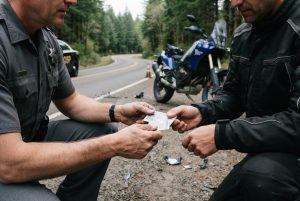
- Contact and insurance details: Obtain the other driver’s name, phone number, address, insurance company, policy number, and license plate.
- Witness statements: If anyone stopped to watch the accident, ask for their contact information. Independent eyewitness accounts carry substantial weight when establishing liability.
4. Seek Immediate Medical Attention
Even if you feel “fine” or high levels of adrenaline are masking your pain, you must see a doctor right away. Conditions like internal bleeding, concussions, hairline fractures, and soft-tissue whiplash often do not present severe symptoms immediately.
Prompt medical evaluation not only safeguards your health but also establishes a clear medical record linking your injuries directly to the motorcycle crash. Delaying treatment gives insurance companies an excuse to argue that your injuries were caused by something else or are not as severe as claimed.
5. Understand Oregon’s Legal Landscape
Navigating an insurance claim or personal injury lawsuit in Oregon involves specific statutory guidelines that can significantly impact your recovery:
- Statute of Limitations: Under ORS 12.110, injured victims generally have a strict deadline of two years from the date of the accident to file a personal injury lawsuit. Missing this window permanently bars you from seeking compensation.
Metier Law Firm - Modified Comparative Negligence: Oregon operates under a modified comparative negligence rule governed by ORS 31.600. You can still recover compensation even if you are partially at fault, provided your share of responsibility does not exceed 50%. Insurers will aggressively try to pin more than half the blame on you to avoid paying out.
Metier Law Firm - Traffic Regulations: Note that lane splitting and lane filtering are strictly prohibited across Oregon under ORS 814.240. Violating this can be used by adjusters to argue comparative fault, making legal representation vital if a dispute arises.
Johnson Law, P.C.
6. Consult a Qualified Attorney Before Talking to Insurance
Insurance adjusters are trained to minimize payouts. They may call you shortly after the crash asking for a recorded statement or offering a quick, lowball settlement. Politely decline to give a recorded statement until you have legal representation.
Secure Legal Advocacy Today
If you or a loved one has been hurt on the road, having an experienced advocate in your corner makes all the difference. Get the guidance and representation you deserve by speaking with a dedicated Portland motorcycle accident lawyer.
Disclaimer: The information provided in this blog post is for informational purposes only and does not constitute legal or medical advice. Reading this article does not establish an attorney-client relationship. Every motorcycle accident case is unique, and you should consult directly with a licensed attorney in Oregon regarding your specific situation and legal options.