

When you are injured in a car crash, a slip-and-fall incident, or any other type of accident in Oregon, the path to recovering compensation is rarely a straight line. One of the most common tactics insurance companies use to reduce or deny injury payouts is pointing the finger back at the victim. They will frequently claim that your own actions contributed to the accident or worsened your injuries.
If an insurer attempts to blame you, it does not automatically mean your claim is dead. Instead, your case becomes subject to a specific legal framework known as modified comparative negligence. At Dawson Law Group, we firmly believe that an insurance company’s assessment of fault should never be the final word. Understanding how Oregon handles shared fault is essential to protecting your rights, and we are here to break down exactly how this law impacts your personal injury recovery.
The 51% Bar Rule: Oregon’s Threshold for Recovery
States across the country handle shared fault in a few different ways. Some use a “pure” comparative fault system, while a dwindling few still use an unforgiving “contributory” negligence model where being even 1% at fault bars you from recovering anything at all. Oregon sits firmly in the middle, utilizing a 51% modified comparative negligence rule.
This rule is codified under state law, which you can read in detail via the Oregon State Legislature’s Revised Statutes. In short, the law states that an injured party can recover damages from an at-fault party as long as the injured person’s own fault is not greater than the combined fault of the defendants.
The 51% Rule: If you are found 51% or more at fault, your right to financial compensation drops to exactly $0.
As long as your share of the blame stays at 50% or less, you retain the legal right to collect compensation. However, there is a catch: your final financial recovery will be reduced by your exact percentage of fault.
How the Math Affects Your Payout
To understand how this operates in a real-world scenario, it helps to look at how a jury or an insurance adjuster calculates damages when shared fault is introduced. Imagine you are driving through a Portland intersection and another driver runs a red light, crashing into your vehicle. However, evidence shows you were traveling roughly 10 miles per hour over the speed limit at the time of the collision.
If your case goes to trial, a jury may determine that while the red-light runner is primarily to blame, your speeding prevented you from taking evasive action. They might assign fault and calculate your damages like this:
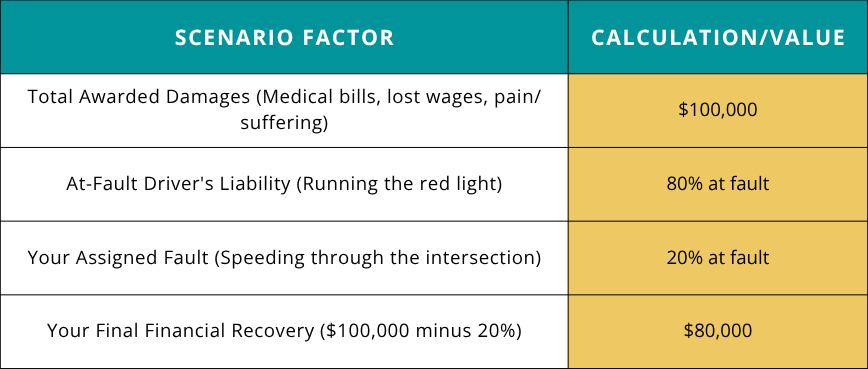
Because your fault (20%) was not greater than the other driver’s fault (80%), you still walk away with a recovery. However, if the jury determined that your speeding was so reckless that it constituted 51% of the cause of the crash, you would receive absolutely nothing.
Why Insurance Companies Love Comparative Negligence
Insurance companies are acutely aware of how this math works, and they utilize it to their advantage during early settlement negotiations. If an insurance adjuster can convince you that you share a portion of the blame, they can systematically chip away at the value of your claim before a lawsuit is even filed.
Common tactics adjusters use to shift blame include:
- Taking your statements out of context during recorded phone calls to make it sound like you admitted fault.
- Arguing that you failed to seek medical attention quickly enough, thereby aggravating your own injuries.
- Using minor, unrelated vehicle maintenance issues (like an overdue oil change or slightly worn tires) to argue your car was unsafe.
Important Warning: Never give a recorded statement to the at-fault driver’s insurance adjuster without an attorney present. They are actively looking for phrasing they can use to increase your fault percentage.
How We Counter Blame-Shifting Tactics
At Dawson Law Group, our experience working on both sides of personal injury litigation means we know the exact playbooks insurance companies deploy. When an insurer attempts to artificially inflate your percentage of fault, we launch an aggressive investigation to establish the objective facts of the case.
To build a bulletproof argument that keeps your fault percentage as close to zero as possible, we routinely:
- Obtain and analyze the official police report and scene diagrams filed through the Oregon Driver and Motor Vehicle Services (DMV).
- Subpoena nearby business surveillance footage, dashcam recordings, and traffic camera data.
- Partner with accident reconstruction experts to scientifically prove speed, impact angles, and braking timelines.
- Interview independent eyewitnesses whose accounts can corroborate your version of events.
By presenting a mountain of undeniable evidence, we force the insurance company to evaluate your claim based on reality rather than their preferred narrative.
Practical Steps to Protect Your Claim
If you have been involved in an accident and worry that shared fault might complicate your recovery, there are immediate actions you can take to safeguard your case:
- Document Everything: Take photos of the scene, vehicle positions, road conditions, skid marks, and weather. Memory fades, but photographic evidence remains objective.
- Seek Prompt Medical Care: Gaps in medical treatment give insurers the perfect excuse to argue you failed to mitigate your damages. Go to an urgent care or emergency room immediately.
- Report the Accident Properly: Ensure you satisfy state reporting mandates by submitting an official traffic accident report within 72 hours if injuries occurred, as detailed by the safety guidelines on the Oregon Department of Transportation website.
- Say Less: Be polite to the other driver and the insurance adjusters, but do not apologize and do not discuss fault on the scene or over the phone.
Contact Dawson Law Group to Seek Help With Your Claim
Oregon’s modified comparative negligence law makes personal injury claims highly strategic. A few percentage points can mean the difference between receiving the full compensation you need to pay off your medical debt or being left completely empty-handed. You should not have to fight defensive insurance corporations alone while recovering from trauma.
Our Portland legal team represents injury victims on a contingency-fee basis. We charge no upfront costs, and we only collect a fee if we win a settlement or verdict for you. Contact us today to set up your free, confidential consultation with our Portland car accident lawyers and let us build the strong defense your claim deserves.